About Me

Biography
I am orginally from a small town in east Texas, but I have since lived in central Illinois and now Tempe, Arizona.
Growing up, I always had an affinity for math, science and technology.
I had a tendency to annoy my parents by taking apart household applicances to see how they would work.
The annoyance came when I presented the assembled appliance back to them along with a set of parts I could not figure out where to put.
I particpated in Number Sense competitions at a young age, and this is something that I can surely attribute a large amount of my fundamental math knowledge.
These competitions consisted of a list of 80 math problems that needed to be completed in less than 10 minutes.
This leaves 7.5 seconds for each problem, so quick thinking is essential.
So much so, that any work shown on the test immediately disqualified the entire test; only answers were allowed to be written.
All of this was prior to entering high school, so going in to freshmen year I knew I wanted to take more math and science classes.
In high school, I took a pretty standard path for those students seeking more math.
This involved doubiling up math classes freshmen year, meaning I was in math classes that were "on track" for students one grade level ahead of me.
Of course, other students did this with me, and this acculmated to an advanced, small class size Calculus 2 and Physics 2 class senior year.
Though, through all of this, I must say that I primarily focused on athletics.
I am a goaltender in ice hockey and I played a lot of travel hockey for a team out of Dallas for most of high school.
With us being 2 hours outside of Dallas, this came with a lot of travel. Not to mention the tournaments that would happen throughout the year.
Travel hockey is a very involved sport, but come college, I only played recreationally.
As an undergraduate, I studied mechanichal engineering because I was very unsure about what I wanted to do.
Mechanichal engineering is such a broad topic that would let me explore a wide range of math and science subjects.
During these 4 years, I explored research in fluids, thermodynamics, controls, biomedical robotics, and mathematical modelling.
I also spent a fair amount of time exploring my own personal engineering interests.
By the time I graduated, I realized knew a large width of engineering topics but not a lot of depth in anything.
I knew I wanted to attend graduate school, but I decided to take just one gap year (at this time) before attending school at the University of Illinois Urbana-Champaign.
During this gap year, I moved to Illinois and got a full time engineering job at a steel foundry.
I went to school for the first few weeks, but I ultimately decided that I was learning a lot more about engineering at this steel foundry than I was as a graduate student.
And, I still had no idea what I wanted to research. So, I worked at this steel foundry for a few years desiging patterns for steel sand castings.
Though, the most interesting and educational project I worked on here was the acquistion and operation of a sand 3D printer.
This was a large overhaul for a small company, and I got to be a very large part of this project.
I worked onsite for about 2 years before moving to Arizona to attend graduate school.
I started graduate school at Arizona State University in August 2024 studying mechanical engineering.
At the time, I was a master's student, but I switched to the PhD program after one year.
I do research on PEEK 3D printed orthopedic implants. The objective of my research is to use biomimetics to develop surfaces that improve the compatibilty of PEEK implants with the bone they are implanted in.
Biomimicry means to take inspiration from nature. Evolution has produced highly optimized structures for performing certain tasks, so taking inspiration from these designs can help use achieve a desired goal.
In this case, the primary parameter I am trying to improve on the implant surface is the surface energy.
So, finding surfaces in nature with high surface energy and taking inspiration from those designs should help us improve these 3D printed implants.
This research is still in it's infancy, but I currently plan to graduate in 2028.
Personally, I really enjoy hobbies like hockey and video games. But, I tend to try a lot of different things!
I love my pets and buidling things for them, building legos with my fiance, or taking pictures of the beautiful Arizona landscape.
As much as I work my mind I like to work my hands. Staying active is important and I cannot stare at a monitor forever!
Professional Work
Process Engineering in Steel Sand Casting
Intern
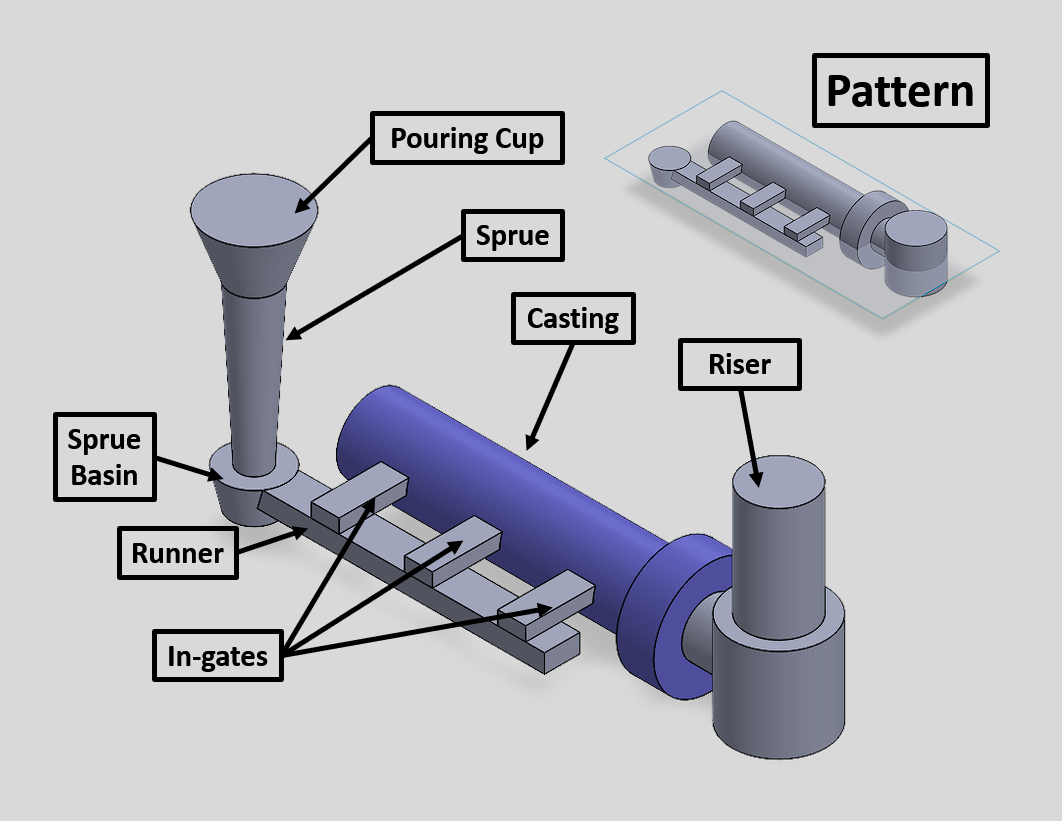
My journey in the foundry industry began in May 2022 as a process engineering intern at Wirco Inc. Wirco is a small-medium size business consisting of a foundry and fabrication shop whose purpose is to produce tooling for the-heat treating industry. I worked in a small team of engineers where my role was to design gating systems and patterns utilizing a powerful software called MagmaSoft; a simulation software for the casting process with detailed controls for mold, melt and geometry parameters. A primary function of mine was to redesign old patterns that were not optimized as they were designed prior to the use of MagmaSoft at the company. Some of these patterns could be optimized with some 3D printed pieces and pattern artistry, but some required a complete new piece to be machined.
One project that stands out to me is something we referred to as the "pie tray". It was given this name because it was a wedge shape and was designed to interlock with itself to form a cirlce. The difficulty of this piece lied in its size. The circle made by this part consisted of 16 pieces, was 16 feet in diameter and weighed nearly 10 tons. This alone provided a challenge to molding as it is physically a large part. However, another challenge loomed since the timing of this order conicided with a lengthy repair on the furnace that can be used to melt up 3000 pounds. With the weight of one casting, and the capability of our largest operable furnace at the time, this gating system needed to accomplish a yield of at least 65%. For steel castings, yields this high are not typically seen. The design of the part itself is similar to what previous engineers have designed solid gating systems for. But, when I designed these gating systems around the pie tray, there was no feasible way to produce a solid casting and achieve the neccessary yield. So, as a novice in the foundry industry I had to use the learning materials and people around me to produce the best gating system possible given the constraints. Ultimately, the castings consistently came out well, with some needing minor weld repair. This project taught me how to digest a complex, but unfamiliar problem and seek out the neccessary resources to guide me to success.
Process Engineer & IT Analyst
In December of 2022, I had recently dropped out of my first semester of graduate school at UIUC and also completed a software engineering course with General Assembly. I went to my managers with this information and presented some of my software engineering work to them. We agreed on a new position where I would continue my current duties in a lesser amount, and begin to take on some internal software development. The tools I developed would be intuitive to use applications that collect large amounts of information from different SQL databases into one place and give the user an interface that enables them to easily access the desired data. The benefit of these would be expedited quoting, better tracking of resources, and conscientious labor management.
As an example of the software I developed and introduced, I will disucss an application I called Pattern Master. The purpose of this tool was to connect PDM (Product Data Management), our current ERP (Enterprise Resource Planning) program, and an assortment of niche excel files. As it stood before developing pattern master, a lot of data was floating about without any real analyzing of it. Not only this, but becasue of the unorganization of large amounts of data, there were numerous instances of inconsistent data entry between different programs. To accomplish this task, I used microsoft queries, SQL, VBA and built 3 different interfaces within an excel workbook to easily search and present the desired data. It was very critical that this was a live document that did not rely on the user changing or updating queries, and these softwares enabled me to accomplish this.
First, the pattern interface showed users pattern locations based on entry, the condition of the entered pattern, and any offsite patterns for orders in the next 16 weeks.
Before, this data was contained on a few different excel sheeets without any real way to search for data.
Now, engineers and pattern shop techs do not need to worry as much about tracking offsite patterns for upcoming orders, offsite sales reps can quickly see the condition of a pattern for appropriately handling customer orders, and everybody can easily find basic information about any pattern.
Second, the mold & core interface showed users information such as mold size, neccessary cores, part & pour weights, and other critical information for an entered part.
What made this interface so useful is that it compared data from different sources and made it obvious to the user if there was inconsistent data entry.
Although, this interface only worked by reading the different sources of data and was not capable of writing to these sources.
This was actually a security risk as it could potentially damage or destroy one of the several SQL databases connected to the interface.
One feature I was really proud of on this interface was a feature that gave the user live links to open the solidworks file of the entered part, and all of the associated cores for this part.
This feature took a while to work on, but it was requested from a few users.
I worked with the engineer who created our PDM database to dynamically query the information I needed to make the hyperlink, and then I built an algorithm that created that link based on the users entry.
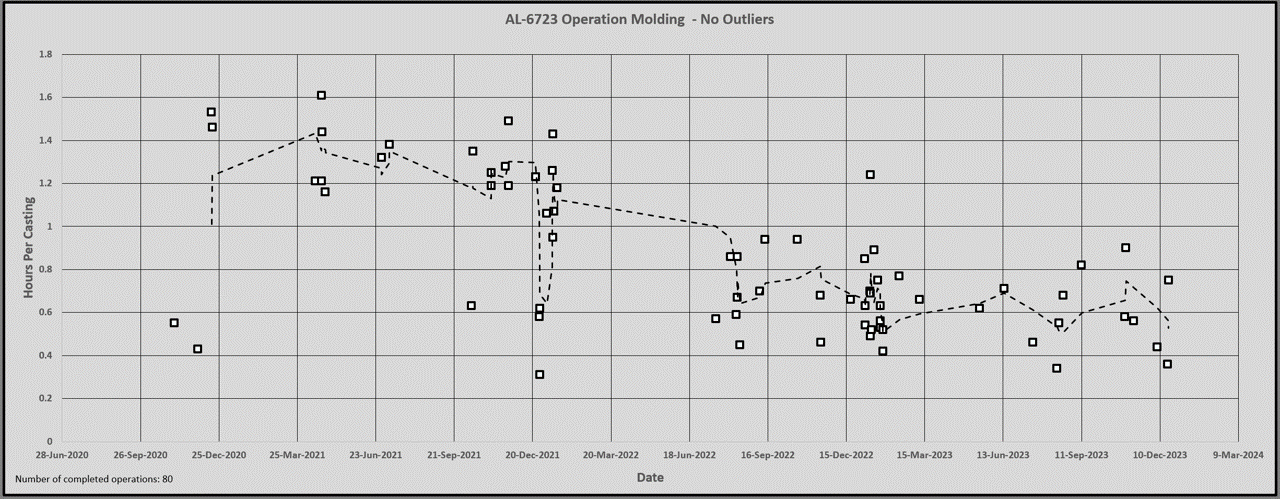
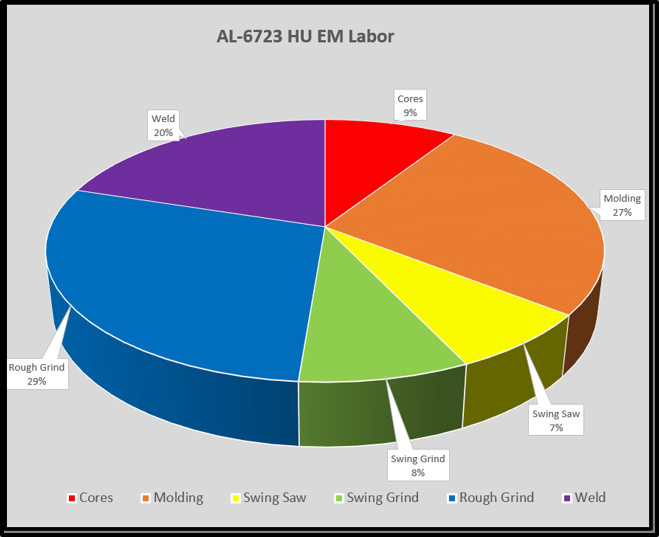
Lastly, the labor interface showed the user all labor information for a specified part. There had been tracking of actual labor data for a while, but it required a lot of manual lookup and math to determine actual labor times for a part. This interface shows the user the estimated labor times (which is used in quoting) for a given operation, and then also shows the users the actual labor times for this part. The actual times includs the average time for an operation, such as molding, the number of times that operation has been completed for that part, and the standard deviation in those labor times. There were also a few different inputs that enabled the user to create a graph that presented what labor resources for this part looked like overtime. For example, a user can type in a part number, select an operation from a dropdown list, such as weld-repair, and view the labor times for this operation over time in a generated graph. This is useful for seeing trends in operations; we should get better at making a part over time. This tool allows us to easily see if this is true for a given part, and if not, which operation is causing labor times to increase.
Pattern Master was certainly my largest software project in my time at Wirco, but I also did many other software and IT projects while continuing my gating design work as a process engineer. I worked on multiple "Costing Cards", which is a term used internally for an excel tool used to quote a specific type of part. These tools took basic entries from users and converted them to an excel sheet that could be imported to our ERP for easy quote creation. I also would take on the occasional IT help desk task as all of our IT staff were located offsite, and provide continuing improvement on the utilization of 3D printing at the foundry, which is discussed in the next section.
Additive Manufacturing
Wirco began utilizing 3D printing in 2016 to help supplement the pattern creation as this department was damaged due to a large fire. Two, cubic meter volume printers were purchased for pattern creation, but by the time I had started in 2022, the use of the printers had shifted to occasional core boxes or pattern modifications. Just a few months after my start date, the engineer who ran the 3D printers left for a different company. One thing that intrigued me was that one of these printers had been defunct since I started. So, in between my assigned work, I would take apart the hot-end and extruder assembly to try to diagnose the problem. I had this experience at home with two of my own printers, so it was familiar, and after a few weeks I was able to get the printer operational.
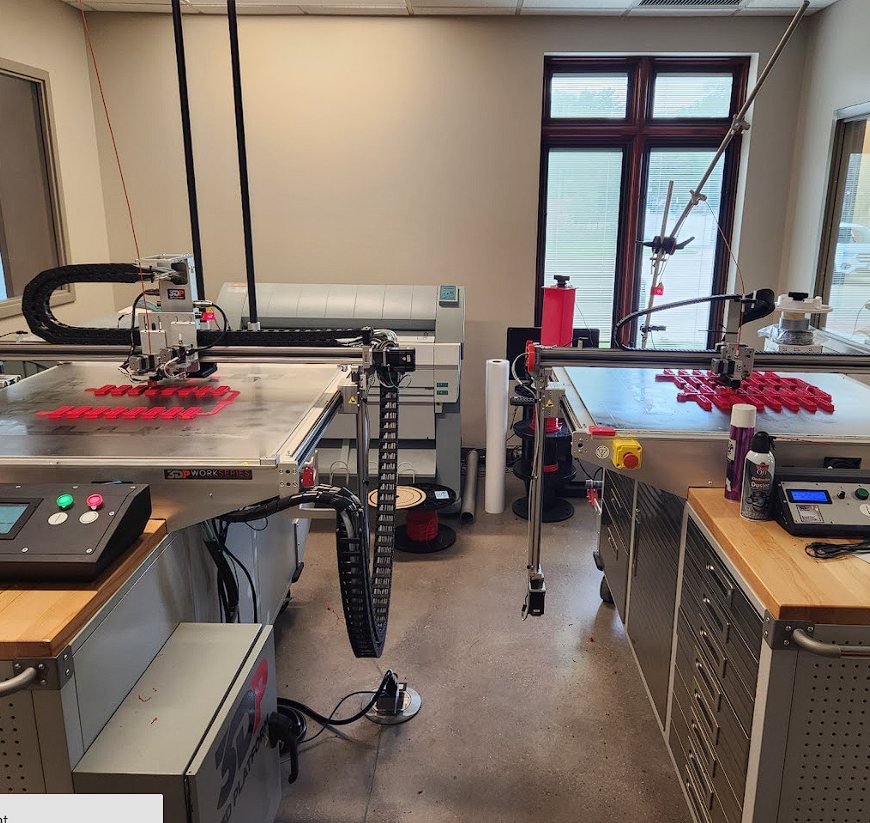
I continued to operate the printers and even introduced some new printers. We got a small ender 3 that is slightly modified to print small parts that can easily be smoothed into a surface empty of layer lines. On core boxes or pattern mods, these layers lines would be transitioned to the sand and subsequently to the casting. The ender 3 removed some of the work on the finishing department as they would have to smooth out the layer lines on each of the castings produced. We also purchased a simple resin printer that is used to make detailed core box accessories such as interchangable nomenclature to denote a serial number, customer name, or alloy.
This proven skill really culminated to the proposal, purchase, installation, and operation of a sand printer. This project began in June of 2023 after one of my managers went to an international conference. I was put into contact with some represenatives of a company making sand printers, and they shared some data that enabled me to do some thorough analysis on the cost of molding versus the cost of printing. Fast forward to September, and I am presenting this analysis in the form of a proposal to some company executives. The main intention of the printer is to utilize hybrid manufacturing; a modern foundry method that utilizes printed cores with traditional molds for a speedy and cost effective process. In short, the reason hybrid manufacturing works so well is that sand printing is extremely cheaper and quicker in making small components, but those advantages dissipate and eventually become disadvantages as the printed component becomes larger.
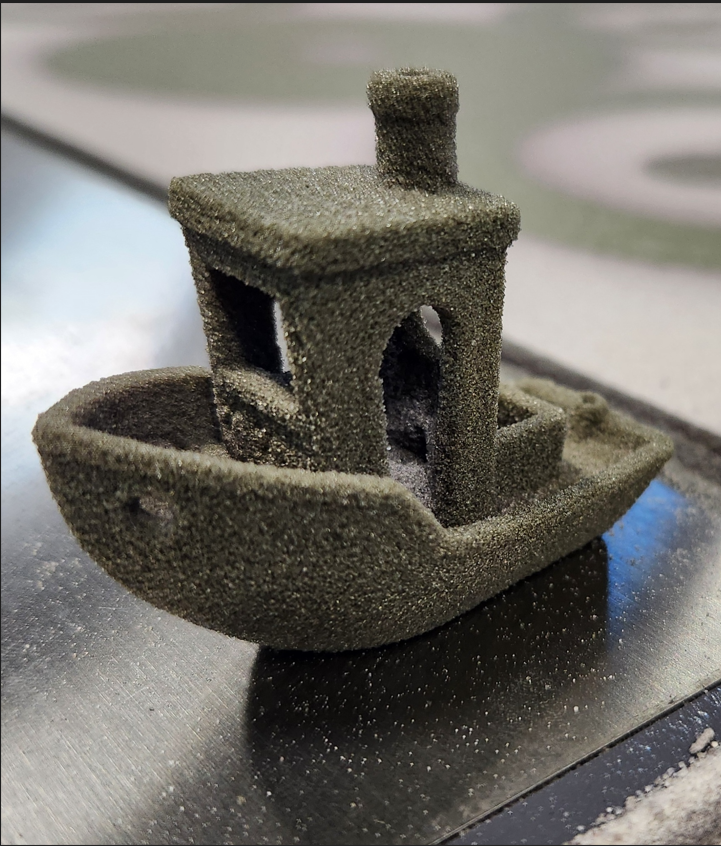
Utilizing sand printing in solely a hybrid manufacturing use-case was very convincing in itself, but there are several other factors that contributed the cost benefit of additive manufacturing. Some being the removal of corebox creation, the ergonomic advantages, and printing commonly used consumables. But, the most critical addition had to be the oppurtunity cost that additive manufacturing presents. Wirco is a job shop, so we take on a range of requests from a range of customers. With this, some of the part designs that are requested are literally impossible to mold, or in such low quantity that tooling costs would make up over half the total order. Before, Wirco would outsource these molding jobs to additive manufacturing companies and then pour the mold within the facility. Now, these jobs could be done in house for far cheaper, and if there is a low quantity order, we are able to offer an option with the removal of tooling costs.
The sand printer project proved to have stressful moments and took nearly a year to go from ideation to integrated operation. However, leading this project was one of the most valuable learning experiences I have gone through. Given my interest in additive manufacturing technologies, I enjoyed it greatly. Seeing this project through and working with the printer to successfully execute ideas we discussed several months beforehand is immensely rewarding.
Tutoring
I began tutoring in January 2019 as a calculus and physics tutor for fellow college students. A study tactic I had found to work well for me was to review material beforehand and then come prepared to casual study sessions ready to assist friends. I am a strong believer, and practicer, that the best way to learn is to teach. This made a strong case for me acquring a position as a tutor, and the following August I began working as a supplemental instructor for Calculus 1.
A supplemental instructor (SI) is very similar to a TA, but with some differences. An SI attends class and holds office hours for students to attend, but an SI does not assist the professor with grading or other general class operation. Instead, the SI fills this time by regularly hosting organized study sessions that consist of group activites, customized study plans and comprehensive reviews.
I enjoyed my time as an SI, but this would be the only semester I would work as one. For the remainder of my undergraduate career, I worked as a tutor in a variety of engineering subjects such as heat transfer, thermodynamics, and fluid mechanics. My preferences to being a tutor over being an SI were various, but the principal reason was the amount of time spent assisting students. I would work more hours as an SI as I would attend class and spend several hours a week creating session/study plans. However, I would spend far more hours assisting students as a tutor since I would not need to create plans or attend class, I would simply assist students as they came to me with questions. Another aspect of tutoring I enjoyed was the progression and variety in the subjects tutoring offered; I was able to start as a calculus/physics tutor and progress into teaching higher level engineering subjects. Because of this, there are some students that I was able to help for numerous semesters and see the progression in both of our knowledge over the different subjects we encountered.
Knowing my elgibility for tutoring was going to expire upon my graduation in spring of 2021, I sought out a position at Upswing so that I could continue tutoring after graduation. My undergraduate university was already partnered with Upswing, so I was familiar with the platform and company. I began in March of 2021 and have since been tutoring college students in mostly calculus and physics subjects. Occasionally I have a student needing help in an upper level engineering course, and those keep me on my toes.